During the last two classes we go over this material to review for the final exam.
To prepare for this discussion, please go over your homework and bring in 2 specific questions on the questions (e.g. clarification of acoustic principles, units, calculations, etc) on November 30th.
Showing posts with label homework. Show all posts
Showing posts with label homework. Show all posts
Tuesday, November 23, 2010

Saturday, November 13, 2010
Homework #6
Homework #6 will be due on Tuesday, November 23 in class.
Exercises come from the end of each chapter in the area titled "Exercises." Specific exercises are labeled after the chapter title so that, for example, Exercise 1.3 refers to the third exercise from Chapter 1.
21.2
21.6
22.6
Exercises come from the end of each chapter in the area titled "Exercises." Specific exercises are labeled after the chapter title so that, for example, Exercise 1.3 refers to the third exercise from Chapter 1.
21.2
21.6
22.6
Thursday, November 4, 2010
Homework #5
Homework #5 will be due on Tuesday, November 16 in class.
Exercises come from the end of each chapter in the area titled "Exercises." Specific exercises are labeled after the chapter title so that, for example, Exercise 1.3 refers to the third exercise from Chapter 1.
23.2
24.2
24.6
25.4
For 23.2 – Assume that occupied seats are upholstered.
Exercises come from the end of each chapter in the area titled "Exercises." Specific exercises are labeled after the chapter title so that, for example, Exercise 1.3 refers to the third exercise from Chapter 1.
23.2
24.2
24.6
25.4
For 23.2 – Assume that occupied seats are upholstered.
Thursday, October 28, 2010
Homework # 4
Assignment #4 will be due on Thursday, November 4 in class.
Exercises come from the end of each chapter in the area titled "Exercises." Specific exercises are labeled after the chapter title so that, for example, Exercise 1.3 refers to the third exercise from Chapter 1.
15.4
16.4
17.2
17.4
Exercises come from the end of each chapter in the area titled "Exercises." Specific exercises are labeled after the chapter title so that, for example, Exercise 1.3 refers to the third exercise from Chapter 1.
15.4
16.4
17.2
17.4
Thursday, October 21, 2010
Final Paper
The final research paper must be five to ten pages long. Because this is a research paper, you must use sources that go into more beyond what is covered in the book and in class. (A hint is to look up articles and books on Google scholar.)
The subject of the paper must relate to some aspect of acoustics, specifically the study of vibrations in the physical world or the simulation of vibrations by means of a computer. For example, this can include the study of a particular aspect of an acoustic instrument, how a computer produces a type of sound effect, how our brain processes some specific quality of sound, etc. It is important that the topic be specific enough that your topic is distinct from other students and so that you can go deep into the research of the topic in the confines of five to ten pages. For example, a paper that focuses on all the acoustics of the piano would have to include far more information than five to ten pages can accommodate.
Each student must submit three proposed topics, listed in order of preferences, at the end of class on Thursday, October 28. The assigned topics will be returned in class on Tuesday, November 2.
The final paper is due in class on December 2. Late papers will not be accepted.
Half of the paper's grade will be based upon the paper's style – in other words, that the paper consistently follows a standard research style (e.g. MLA, APA, Chicago, etc. The other half of the grade will based upon the content – does the writing make sense, is it well written and clear, etc.
Tuesday, October 19, 2010
Video of Today's Demo
Ring Modulation Patch (HW 7.8)
Thursday, October 14, 2010
Homework # 3
Assignment #3 will be due on Thursday, October 21st in class.
Exercises come from the end of each chapter in the area titled "Exercises." Specific exercises are labeled after the chapter title so that, for example, Exercise 1.3 refers to the third exercise from Chapter 1.
8.2
8.6
9.8
Exercises come from the end of each chapter in the area titled "Exercises." Specific exercises are labeled after the chapter title so that, for example, Exercise 1.3 refers to the third exercise from Chapter 1.
8.2
8.6
9.8
Thursday, October 7, 2010
Home Lab Assignment
Home Lab (HL) preference – due Thurs. 10/14/10
Read description of the “Experiments for Home, Laboratory and Classroom Demonstration” at the end of chapters 1-7.
Experiments can be done in pairs, so choose your partner or small groups of three or four.
Choose 3 experiments and rank them according to your preferences (1 highest – 3 lowest).
Submit a list of HL preferences with all the members' names on it.
We will try to sort out your list so as to accommodate as many preferences as possible.
On Th. (10/21) evening we will publish the final HL assignments
(check email / see web link below).
HL are due Tuesday 10/26/10 (one weeks) as a presentation in class during approx. 10 min.
Presentation should include a one page written description of the experiment.
Also prepare a separate page only with your names and the Lab title on it
Homework 2
Assignment #1 will be due on Thursday, October 14th in class.
Exercises come from the end of each chapter in the area titled "Exercises." Specific exercises are labeled after the chapter title so that, for example, Exercise 1.3 refers to the third exercise from Chapter 1.
5.2
5.4
6.2
6.6
7.2
7.4
7.8
Exercises come from the end of each chapter in the area titled "Exercises." Specific exercises are labeled after the chapter title so that, for example, Exercise 1.3 refers to the third exercise from Chapter 1.
5.2
5.4
6.2
6.6
7.2
7.4
7.8
Tuesday, September 28, 2010
Assignment #1
Assignment #1 will be due on Tuesday, October 5th in class.
Exercises come from the end of each chapter in the area titled "Exercises." Specific exercises are labeled after the chapter title so that, for example, Exercise 1.3 refers to the third exercise from Chapter 1.
For this week only, the specific Exercises are copied from the book below.
Please write out your work to insure that can you get credit if you make a partial mistake when preparing your answers.
1.2 The speed of a bicycle increases from 5 mi/h to 10 mi/h in the same time that a car increases its speed from 50 mi/h to 55 mi/h. Compare their accelerations.
1.6 An object weighing 1 lb (English units) has a mass of 0.455 kg. Express its weight in newtons and thereby express a conversion factor for pounds to newtons.
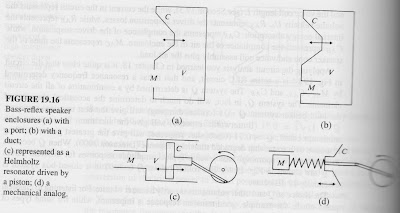
2.4 A bass-reflex loudspeaker enclosure (see Fig. 19.16) is essentially a Helmholtz resonator. Given the following parameters, what resonance frequency might be expected. V = 0.5 m^3, a = 0.02 m^2, l = 0.05 m, speed of sound v = 343 m/s at T = 20˚C.
2.6 In the two-mass system shown in Fig 2.7, each mass is 2 kg and each spring constant K = 100 N/m. Calculate the frequencies of modes (a) and (b).

3.2 Two trumpet players tune their instruments to exactly 440Hz. Find the difference in the apparent frequencies due to the Doppler effect if one plays his or her instrument while marching away from an observer and the other plays while marching toward the observer. Is this enough to make them sound out of tune? (Assume 1 m/s as a reasonable speed.)
3.4 At what frequency does the wavelength of sound equal the diameter of the following (1 in. = 0.0254 m)
(a) a 15-in. woofer
(b) a 3-in. tweeter
4.6 A nylon guitar string 65 cm long has a mass of 8.3 * 10^-4 kg/m and the tension is 56 N. Find the frequencies of the first four partials.
Exercises come from the end of each chapter in the area titled "Exercises." Specific exercises are labeled after the chapter title so that, for example, Exercise 1.3 refers to the third exercise from Chapter 1.
For this week only, the specific Exercises are copied from the book below.
Please write out your work to insure that can you get credit if you make a partial mistake when preparing your answers.
1.2 The speed of a bicycle increases from 5 mi/h to 10 mi/h in the same time that a car increases its speed from 50 mi/h to 55 mi/h. Compare their accelerations.
1.6 An object weighing 1 lb (English units) has a mass of 0.455 kg. Express its weight in newtons and thereby express a conversion factor for pounds to newtons.
2.4 A bass-reflex loudspeaker enclosure (see Fig. 19.16) is essentially a Helmholtz resonator. Given the following parameters, what resonance frequency might be expected. V = 0.5 m^3, a = 0.02 m^2, l = 0.05 m, speed of sound v = 343 m/s at T = 20˚C.

2.6 In the two-mass system shown in Fig 2.7, each mass is 2 kg and each spring constant K = 100 N/m. Calculate the frequencies of modes (a) and (b).

3.2 Two trumpet players tune their instruments to exactly 440Hz. Find the difference in the apparent frequencies due to the Doppler effect if one plays his or her instrument while marching away from an observer and the other plays while marching toward the observer. Is this enough to make them sound out of tune? (Assume 1 m/s as a reasonable speed.)
3.4 At what frequency does the wavelength of sound equal the diameter of the following (1 in. = 0.0254 m)
(a) a 15-in. woofer
(b) a 3-in. tweeter
4.6 A nylon guitar string 65 cm long has a mass of 8.3 * 10^-4 kg/m and the tension is 56 N. Find the frequencies of the first four partials.
Subscribe to:
Posts (Atom)